Thursday, July 13, 2023

Jazz Colony 2023 Kickoff - 7/11

 Jazz Colony is BACK! 

Flourish: Bloom Where You Are Planted! 


Tuesday, July 11 Jazz Colony Combo Improv Workshop Resumes.  

This blog is intended to help players remember what happened as well as catch up students who may have been away for this session.  If you practice daily as though you're watering a young plant, you'll notice growth.  Don't take days off or your enthusiasm may wither.

Here are some notes of what we worked on ...

Honeysuckle Rose Combo - Schatz/Steinke - A103

Hey, here is the recap for week 1.
 
Thanks to Milo Petersen for helping our combo get off to a strong start! Milo gave us a beautiful history lesson on the Blues and gave some key context of the art form of Jazz. Thanks to everyone who could make our first session. 
 
An overview of various topics covered:

We settled on Royal Garden Blues as one of our two tunes and spent the majority of our meeting covering the basics of the blues form. The blues is a 12-bar form with the first four bars being Bb7, bars 5-6 F7, bars 7-8 Bb7, bar 9 Eb7, bar 10 F7, bar 11 Bb7, and optionally bar 12 F7.  Written out like this it seems confusing, so please find a blues lead sheet or make your own! 
 

We had a mini music theory lesson discussing the three major diatonic (diatonic meaning ‘of the scale’) triads of the major scale (the one, four, and five chords). This means that assuming the major scale of Bb, the triads built from Bb (one) Eb (four) and F (five) will all be major triads. Coincidentally these are the 3 fundamental chords found in a 12-bar blues. What distinguishes the chords of the blues however are their flatted 7th scale degrees. We call these dominant chords/scales, 1 3 5 b7, which as Milo taught us informs the musician that these chords, Bb7, F7, and Eb7 all belong to various major scales which are not to be confused with the root of the chord. They are all the 5th mode of their parent major scales, Eb, Bb, and Ab respectively. 
 

To recap the music theory lesson, when soloing on a Bb major blues, we can think and make use of both the 3 major diatonic triads found in our Bb major scale Bb (D F), F (A C), Eb (G Bb) over their respective chords Bb7 F7 and Eb7, and/or think of the 7th chords (triads with an added note a diatonic third above the 5th) and their own parent scales. So Bb D F Ab (which all belong to the Eb major scale, F A C Eb (Bb major scale), and Eb G Bb Db (Ab major scale). We have triads, 7th chords, and chord scales all available to us here.
 

We then applied this theory in practice, first playing our 3 triads at the appropriate times over the blues form, then playing our 7th chords, then playing a common music shape ‘1 2 3 5’ of each chord (being able to think of scales and chords in relation not to their musical names but in relation to numbers is an essential method in music. In the key of Bb major, 1 is Bb, 2 is C, and so on). After getting comfortable with these triads, 7th chords, and shapes, we explored playing improvised solos. Note, this is a fundamental way to learn tunes in Jazz; it is always up to the musician to extend these exercises into new and challenging ways. Once you have mastered the three exercises above, find permutations that will deepen your understanding and ability. For example, can you play the triads in all three inversions at will? Can you play the 7th chord inversions? Pairs of diatonic triads from the same chord scale like 1 and 2, 5 and 6? Chord scales? Extensions beyond the 7th scale degree, like 9, 11, and 13? 
 
Two assignments were given to combo members for next week. Listen to as many classic recordings of Royal Garden Blues as possible with the goal of transcribing the main melody and any other line or harmony part you feel inclined to lift. Practice soloing over Bb and F blues with the above-mentioned theory front of mind. Please reach out to me at joelsteinke@comcast.net if you have questions or need clarification on the assignments or the topics covered from week 1. Happy practicing!

Little Sunflower Combo - Eisenmenger/Salas

  • General introductions, name choosing, etc.
  • Learned Sonnymoon for 2 by ear
  • went over the chord changes for a blues in C, Eb, and Bb
  • sung the roots in time, also sung 1st and 2nd scale degrees in time
  • Went over the importance of singing when playing
Homework:

Familiarize with Bb mixo, Eb mixo, F mixo, and C Dorian

Horns: find a solo you dig
Bass: transcribe a chorus of Bb blues from "Sonny Moon for Two
Drums: find a chorus of comping with a texture you enjoy

This I Dig of You Combo - Summary: 07/11/23 - A112 Bergevin/Fox

A brief overview of what we covered:

Andrew provided a short discussion of early jazz (also called dixieland or New Orleans style jazz) and its roots and ongoing importance. In short, it’s important to know the history and origins of jazz to understand the cool things we hear later players doing. We then listened to a recording of the Preservation Hall Jazz Band playing “Joe Avery’s Blue/Second Line”.

Here’s the recording we listened to.

Here’s an additional recording that highlights the “marching band” snare

We touched on the differences in instrumentation and style from more modern jazz forms:
      - addition of banjo, clarinet, and tuba/sousaphone
      - collective improvisation
      - individual improvisation backed up by improvised harmony

After listening to the tune we learned the melody by ear. We listened to Andrew play the melody first, then hummed along, then sang along, then started to play along. Once we had it, we played the melody as a group several times through. This pattern: listen - hum - sing - play is a good workflow for learning tunes and transcribing solos. Learning them this way with a lot of repetition leads to much deeper internalisation than reading a lead sheet ever will.

We also practiced counting off and establishing a groove. Everyone took a turn counting off the tune, followed by us playing the melody through. The count-off is an important part of establishing not only the tempo, but the mood and style of a piece.

Once we had the melody down, we tried breaking away from it a little bit into some collective improvisation. The idea was to change the melody a bit, while staying close to the notes (happily, the notes of the melody outline the chords of the blues!). Collective improvisation is useful for a few reasons:
      - the emphasis on the melody engrains it in your memory, and grounds your improvisation
      - no need for a rhythm section! The other horns playing create the harmonic background

After this we jumped forward about 40 years and listened to “This I Dig of You”. We took turns noting things that we really liked or noticed about the recording. Observations included:
      - and the enormous buildup of energy of the break before the piano solo
      - tension and release - a concept we’ll return to…
      - the rhythmic freedom of both Hank Mobley’s saxophone and the rhythm section
      - the intense groove of the bass when it starts walking
      - the repeating pattern in the bass and piano during the latin section
      - how tasty that opening line of the piano break is!

Here’s a recording of “This I Dig of You”

And the full album!

Next, we learned most of the head by ear, following the same pattern of listen - hum - sing - play. We identified a difficult section - where the melody moves up a half step before shifting back down. Planing is when a melody is played in one key, then shifted up or down and played in another key. It creates a sense of “parallelism”, as you hear the same material shifted from one key centre to another.

Finally, we spent the last 20 minutes playing Song For My Father. Takeaways included the potential difficulty of the AAB form, and the acceptability of light comping over a bass solo (especially in the upper end of the piano keyboard)

We didn’t listen to it, but here’s the recording

Bonus content: The changes to Song for My Father go: Fmin7, Eb7,Db7,C. This is an example of “harmonic” planing. Can you see why?

Assignments for next time:
      - finish learning the head to “This I Dig of You” by ear
      - play Bb major scale in thirds
      - Fox’s bonus extra credit: play Second Line/Joe Avery in another key

  • AJF
You Are My Sunshine Combo - Stage - Bennett/Tran

We introduced ourselves, and shared how many hours we slept the night before. It was an awkward prompt but it got us a little insight into each other’s lives. 

We learned the head of Take the A-Train (in Concert C), using numbers instead of Notes for the melody. To help with improvising, we played the root, third, fifth, and seventh of each chord, hoping that this arpeggiating would translate into our solos. We also learned the intro, ending, and second melody of Take the A-Train, basically learning the whole tune. 

For this years theme (Gardening), someone came up with the idea that we should go the opposite direction. We came up with “Sandu” (like the sand in a dry desert), a blues in the home key of Eb. We already knew the tune, so we ran through it nice and slow.

For a little homework, we thought each of us can go home and cook up a nice and simple melody over Blue Bossa changes for our new contrafact, “Bloom Bossa”, or how Woods Jarol would spell it “Blume Bossa”. It’s not set in stone that we would ever perform this, but it sounds like it would be fun to at least give it a try.

-Don T

Hot House Combo - Glynn/Kimani


First our combo got to know each other's names, grades, and instruments. Then Michael Glynn, our head coach, passed out the first song which was Cedars Blues, by pianist Cedar Walton. He had the horns rehearse the melody and practice playing it perfectly without messing up the complicated rhythms. Then when the horns went into harmony there were intonation issues and due to lacking a third voice in the chord, it sounded a little off. So on piano I played the chord voicings to help the horns. Michael explained that it takes a little while to get the dissonant sounds of some jazz chords into your ear. Next we went over the final 4 bars of Cedar’s Blues in which the horns are playing in 3 part triadic voicings. Mr. Glynn explained what, “ped” means, as it means pedal and it means that the bass and piano are playing the same not over and over in the same rhythm. 

Then I explained to the saxophone players in the group how to play with a big sound. I explained that you have to drop your jaw and relax your bottom lip and roll it outwards in order to make sure the reed vibrates as much as possible. You also have to push your mouthpiece in as this will make your saxophone flat so to compensate. Finally you have to use a lot of air support from your diaphragm.


     We then discussed improvising on the blues form. Mr. Glynn explained how to use melodic and rhythmic motifs to make the solo more interesting to listen to. We also talked about using the blues scale (1, b3, 4, b4, 5, b7) in a major key. And we talked about the major pentatonic scale, 1, 2, 3, 5, 6). 


For our next song we played lotus blossom by Billy Strayhorn. This song is a bit trickier to solo on and we discussed using the chord tones of each chord to solo over it. The chord tones are the root, third, fifth, and 7th. For example the chord tones of a Bb major chord are Bb, d, f, g. We also discussed using the pentatonic scale and major scale and using melodic riffs to improvise. Mr. Glynn explained to our drummer the different drum feels for playing a waltz and where to play the hi hat (on the second beat). 


Songs to listen to: https://www.youtube.com/watch?v=g0oLYCdoDC8

Cedar Walton Quintet - Cedar's Blues


Talli Kimani

Tuesday, February 21, 2023

Edmonds Jazz Walk - 2nd Annual Event - June 3

Stay tuned for more info about the 2nd annual Edmonds Jazz Walk. Here's a blurb about last year... https://visitedmonds.com/blog/post/edmonds-jazz-walk-2022- Supported by The Jazz Colony and Jazz Clubs NW https://www.jazzclubsnw.org/

Saturday, August 13, 2022

August 10 update

Final performance has been moved to 1 PM on Sunday, August 28. Please make a note of it. Yesterday we dove into creating background lines during someone else's solo. We talked about how to lead that and the importance of coming up with short repeatable phrases for those. We finished our tune "Leo." I can send you a pdf if you were absent! Homework for Leo - either practice one of the "licks" we came up with over the changes (transpose it over the different chords!) or come up with your own. Options were come up with: option 1) 9 9 1 9 1 4 option 2) 1 3 5 7 6 9 4 or option 3) 7 7 1 9 1 7 6 . Solar: We are playing this as a bossa! In practice your improv this week - see how long you can string together eighth note lines! Can you play for 4 measures? Challenge yourself to keep playing! - Christine Here is the Star Eyes Combo Summary from Tuesday. Today the Star eyes combo worked on reviewing our arrangements on Cashews (the Peanuts themed F blues) and brainstormed ideas for a third tune. On Cashews, we decided on what Paul described as a Bugaloo feel for the head with a repeating funky bassline based on the original peanuts theme. The intro features Spencer and Waylisha on the bassline while Josh, Marcel, and Ella play harmonies on top. For solos, we decided on switching in between swing and the Bugaloo feel for variety. At the end we are doing a tag ending. For another tune we have tentatively decided on Groovin High from the packet, although we reviewed other ideas as well. We played through the head and took solos focusing on expressing musical “ideas” rather than just playing the changes. It is good to know the changes, but ultimately the ideas/phrasing are more important than hitting all the right notes. Remember to keep track of the form of the tune as we play through these. Nice work everyone! This was my last session (Brandt). So I hope the performances go well. It was a pleasure working with you all. Homework: -keep practicing the blues, Star eyes and grooving high -listen to the styles we are playing in: swing, Latin-jazz, and Bugaloo. Notice how we might solo differently in each style -practice the key centers of Groovin High. Each II-V-I is in a key center we can identify and practice. -think about which tunes you would like to take solos on for the performance. Thanks, Brandt

Wednesday, July 27, 2022

July 26 - Getting Hot!

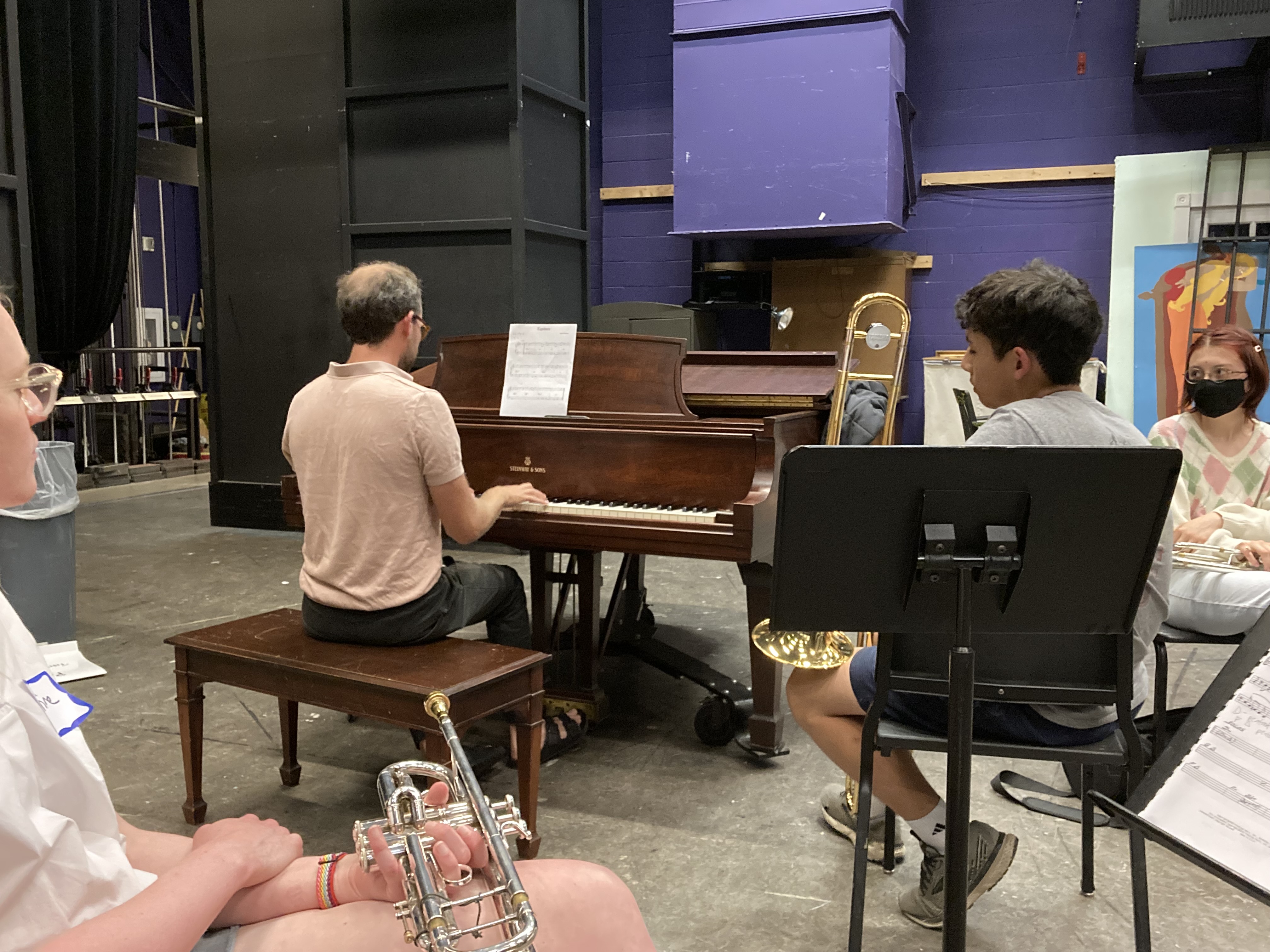
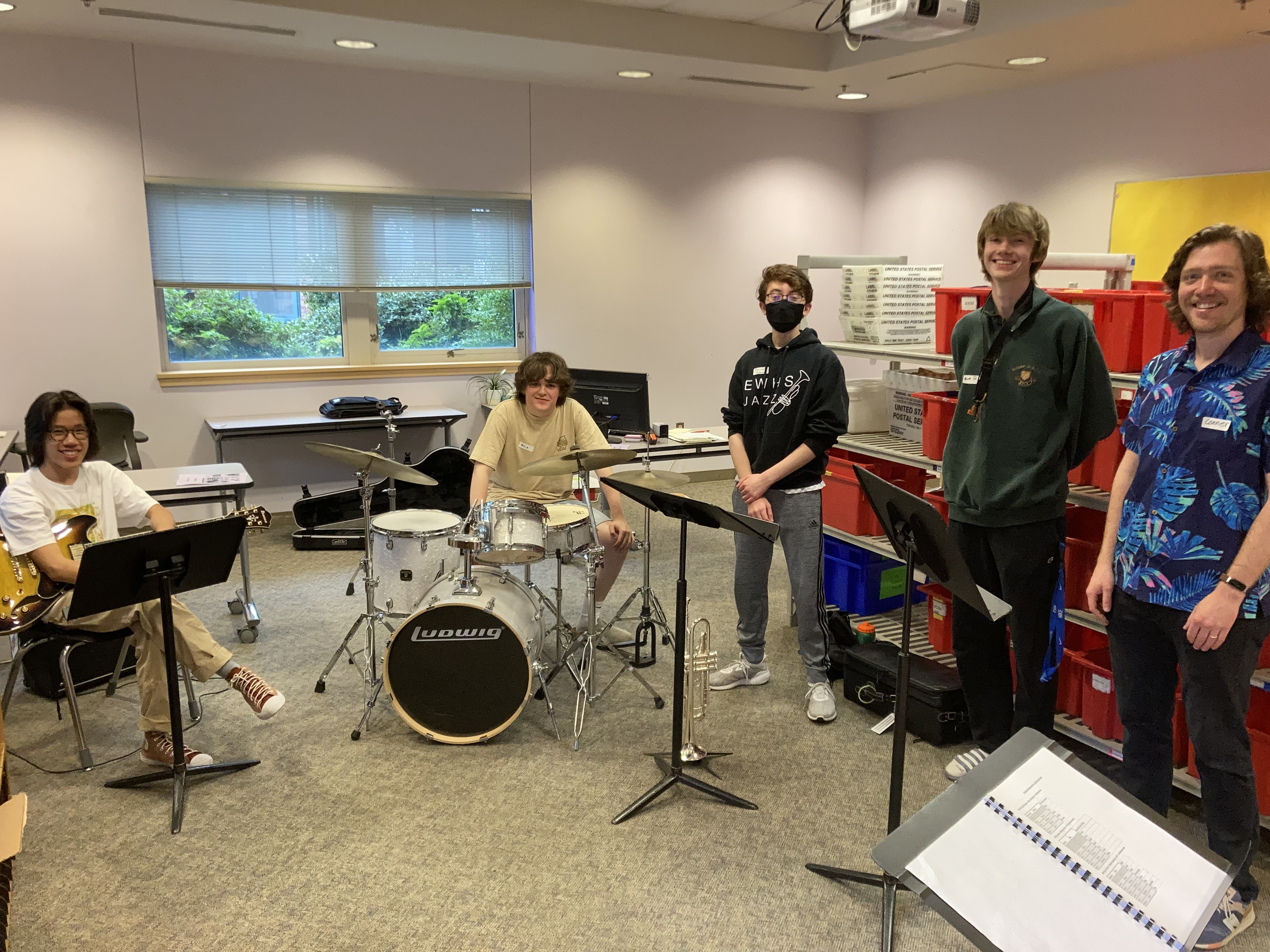
Jazz Colony at EWHS continues with chamber groups too.  The weather is getting hot so the chamber groups stayed outdoors in the shade. 

Romeo's Jam this THURSDAY - July 28 at 7 PM featuring Reuel Lubag on piano. https://www.youtube.com/watch?v=oXwTfNPWn-Q

COME OUT & JAM with EWHS players on Wednesdays at Sea Jazz all summer long. 5-7 PM.

https://tinyurl.com/mr34zbbf

 Address: 458 Admiral Way behind Anthony's Beach Cafe 


At this Tuesday's Jazz Colony session it was especially nice to have some notable alumni drop in including Devon Yesberger and Andrew Fox.  Check out Devon's website for some cool free online lessons ...

https://yesbergerplease.com/


Some key advice from Mr. B - "strive to develop your 'hearing eyes' and 'seeing ears'.  All groups continue to strive to be creators while also working on achieving a BIG TONE.

Here's the practice log link - try to create some new habits this summer?

https://forms.gle/dg3CzM5hjFNG5nC69

Rehearsal summaries:

Star Eyes Combo:

This rehearsal we continued to work on “Star Eyes” and “Now’s the Time.” For the blues we learned about the leading tones of the blues, the thirds and sevenths and how they lead from one to the next in the 1, 4, and 5 chords of the blues. We then passed around a call and response exercise trying to play confidently and develop a melodic idea into our own spontaneous “blues head.” Possibly, a member of the group will write us an F blues head, so we don’t have to play “Now’s the Time“ anymore. Everyone did a nice job, and we are getting more comfortable with the blues every time we play it.

On “Star Eyes” we reviewed our triads exercise from last week. We also spent time with the chord movement of the A section of the tune playing just the roots of the chords, just the thirds, fifths, and finally the sevenths. This kind of work helps us the expand how we hear the changes and encourages us to start our musical on notes other than the root. We then spent some time soloing on this tune trying to hit the new key centers when they come up.

Homework:
-continue to practice Now’s the Time and Star Eyes with backing tracks
-Think about a 3rd time our group could play?
-when at home, play with TONE! Focus on air speed and breath to create a beautiful tone while practicing jazz as well as our technical exercises

Bonus Homework (optional):
-write an F blues head (a contrafact) and bring it in for us the replace Now’s the Time

I can hear us getting better every week :) ~ Brandt

Tuesday, July 26 2022


This week, we worked on the same tunes as last week with a focus on “Skylark” and “This is For Albert." Copies of charts can be found at the following link: https://drive.google.com/drive/folders/1TcU23WhIkX_lqQWQUCPd7FnMc-AsELNa?usp=sharing


“Skylark”:

Horns- I hope y’all are ready to blow over this when you get here.  Make sure you can play the melody convincingly as if you were a soloist.  We will divide the head into sections for each of you to shine.


Rhythm- Loved the samba groove we settled on, but wasn’t thrilled by our collective “open feel.” check out some more Gretchen Parlato stuff with Mark Giuliana on drums to get some inspiration.  I’ll be shedding my Fabian Alamazan impression! Additionally, this tune would be a great candidate for a drum solo w/ comping behind it. We will keep the vamp in the end the same.


“This is for Albert”:

Boy is that head tricky.  Nice work figuring out the Blakey-isms in the “A” sections, Max.  The hits in the sections that follow the pedals are still tripping up (myself included). Also, listen to how the soloist on the record blow over the “Gmaj7 +4/C#” in the bridge.  It’s simpler than you might think!


Thanks again and hope to see more of you next week.

-Conner


Hi Fly Combo - We took each section of the chords to Hi-Fly and repeated them, playing patterns 1 2 3, 1 2 3 5, and explained the modes for each chord. Showed the drummer some new Afro-Cuban grooves. ~Milo


Yesterday we continued working on Solar and Equinox. On the tune Solar, we focused on our guide tone lines using 7ths and 3rds. If that's still a struggle, practicing slowly out the playing chords 1 3 5 7 can help solidify mentally being able to find the near guide tone as you play through the form. Our goal in improvising on this tune was taking a shape and playing it over all the changes. Some example shapes were 5-3-1, or 1-2-3-2-1. Practice goal: make up a short shape and play it over the changes with this play laong: https://www.youtube.com/watch?v=JvpJEMVGijQ&t=22s&ab_channel=GuitareImprovisation

For Equinox: improvise, and repeat! We got a good handle on the changes, now our goal is to get more confident soloing for more than one chorus. Pick an idea and repeat it while improvising with good tone! Practice goal: come up with a new melody (Leo!) on these changes! We'll have Leo vote on his favorite next week. Play along: https://www.youtube.com/watch?v=W61cA8vQrjU&ab_channel=M2

Christine 

Stars Fell on Alabama Combo:
Our combo did some listening to a live Marcus Miller recording from 1992 called "Run for Cover" https://youtu.be/cHf7DvVpeiU We talked about playing with style and showmanship and the elements of good solos (developing short ideas and leading to longer ideas, high notes, tricks). We also talked about learning; specifically we talked about more structured learning habits (such as making lists and checking off goals) versus more inspired and exploratory learning (such as going deep into a recording or learning songs). In terms of playing, we learned how to trade 4s with the drummer (and how to keep the form) on the blues. We discovered that playing memorable ideas allows for some fun interactions between the drummer and instrumental players. Additionally, we broke up into instrument specific groups and worked on our own stuff (saxes, brass, and rhythm section). Saxes specifically transcribed a lick from the Sonnymoon recording and talked about the circle of 5ths.

Homework: Check out the Ray Brown Trio's record called "Summer Wind"https://youtu.be/DsVDeLUdk44 and come back with 3 specific things you liked. Think also about the musical communication between the musicians. Additionally keep working on the melody to Solar by Miles Davis https://youtu.be/wszvzhsHI9U as well as working on playing Sonnymoon for Two https://youtu.be/DXMwHVM113s .
- Max B


Sea Jazz on 7-27 photos 
Thanks to Lilia Sanders, Reuel Lubag and Max Bartron


Romeo's Jam on 7-28, 7-9 PM


Tuesday, July 19, 2022

Jazz Colony - July 19, 2022 - Straight No Chaser


 Glad to have these swanky new shirts with logo design by Nick Loyd. 

Every Jazz Colony Student would benefit by studying the blues.  Here's a recording which is recommended for all to listen to and choose a favorite chorus or 2.

Miles Davis - Straight No Chaser

https://www.youtube.com/watch?v=ooS2i65-vk8

Mr. B posted a progress chart in the class to help students that need a goal for their personal practice during the summer. Here's a photo of the physical chart ...


Across the top are a few items which could be addressed each week. Students that accomplish the tasks will earn points for their ensemble (and themselves). Most importantly, you'll notice improvement if you have a systematic approach.  Some items which are listed include:
  • transcribing
  • intentional listening (to jazz)
  • attending a jam session (like Sea Jazz or Romeo's)
  • practicing independently and logging your progress in a notebook (or phone)
  • memorizing a melody
  • playing any lick in all 12 keys
  • attending a live performance 
  • working on any audition material
  • taking a real live lesson in person 
  • sight reading (alone or with a buddy)
  • playing scales and arpeggios (or rudiments)
  • optional area of interest
Take a moment to fill out this google form instead of using the chart in the band room?

Here are the rehearsal summaries:

Solar Combo: Today we worked on transcribing Miles Davis' solo on Now's the Time. We learned the melody and learned the first two bars of Miles' solo that starts at 1:44. We decided a good practice goal would be to learn the first chorus of his solo. Singing first, then noodling, then playing in rhythm in small chunks seems to work best! We worked on Solar, writing out the chord tones on each chord and practicing a guide tone melody.  Practice goal this week: improvise on Solar with two techniques - improvising off the guide tone line (keep coming back to the guide tone!) and then improvise using the melody to guide the solo. Decide what technique you are going to use before you play. Also this week - memorize the melody of Equinox. ~ Christine H

Hi-Fly Combo - Homework for this week:
Take every note in any scale and stack the 7th chord and number each chord with its value. This is called Diatonic 7th chords. We will be playing High Fly and Straight No Chaser so I would recommend going through this process with those tunes as well.  ~ Cedar

This week in the Stars Fell on Alabama combo, we started by listening to Roy Hargrove, and went around the room and identified our favorite parts of the music, which include Roy's unique and beautiful tone on the trumpet, the excellent comping and time feel in the rhythm section, and the joyful feeling of the band. Here it is if you want to listen again: 

Then, we worked on soloing over the twelve bar blues, and specifically honed in on keeping the form over minimal hits in the rhythm section that we lifted from the recording of Sonnymoon for Two. We continued to work on non-verbal contact, and tried to pass solos and comunicate with each other through eye contact as we played. Finally, we transcribed the first 8 bars of Miles Davis' Solar by listening, collaborating, and recognizing patterns in the melody. Everyone is encouraged to learn the rest of the melody by next week, as well as work on transcribing Miles' solo on Now's the Time. - Jack Hillman

Here is the Star Eyes Combo blog summary:

This week we worked on the tune “Star Eyes.” We listened to versions by Sarah Vaughan, Charlie Parker, Cannonball Adderley, and Roy Hargrove. Our combo learned the melody and started talking about playing over chord changes. Focus was on learning the major, minor, and diminished triads at the base of each chord. We played an exercise outlining the triad for each chord as it went by during the tune, and then tried soloing using only notes from each triad.

It is difficult to play with only these select notes, but when we put restraints on our solos it trains us to internalize the tune in a new way. And, exercising like this can spark creativity in our playing.

Afterwards, we briefly reviewed “Now’s The Time,” focusing on soloing with thematic development: taking one idea and playing it repeatedly with variations over a chorus of solo. Mr. B came in and reminded us to use proper airspeed and create more tone on our instruments while we play. Our tone is our “musical handshake.” Call and response exercise ensued, with a focus on creating more tone. This made a big difference.

Homework:
-review Star eyes melody and listen to a version you like
-practice the triads to the Stay eyes changes along with a backing track/recording
-practice playing with more TONE, do scale warm ups and long tones while focusing on the tone you create in your instrument.

Nice job this week! It’s great to see everyone progressing. Thanks for the good work.

-Brandt
Virgo (Horace Silver)
Practice the head (horns) and familiarize yourselves with the figures (rhythm section).  When playing fast, think slow.  This means feeling larger subdivisions of the beats and generalizing harmonic concepts while blowing.  If you try to cram everything you know into each ii-V, it's going to sound like just that. Time and a light, gliding swing feel are of the essence.

recordings for reference:

Skylark (Hoagy Carmichael)
Check out the changes, they are heavily reharmonized.  The theme of the week continues to be the family of Sus chords and how to effectively improvise over them.  While this largely depends on context, we are trying out the use of 1-2-3-4-5 shapes in Natural Minor one whole step above the root of each sus chord (e.g., B sus13= C# Minor, Ab sus13= Bb Minor).

recording for reference:

This is for Albert (Wayne Shorter)
We haven't spent a great deal of time on this, but it would be good to familiarize ourselves with the tune. This is, of course, a dedication to Albert II, who was the first mammal to go into space. 

Horns: Follow along with the recording and figure out your parts in the divisi sections (trumpet plays top line, tenor plays middle line, and I'll play the bottom).
Rhythm: Check out those pedals and breaks, some happen in the blowing, some don't. Some only happen sometimes.  Also, I love what Art Blakey is doing on the hi-hat/rim clicks at the top of the form.  Maybe we can lift that?

recording for reference:

--
Conner Eisenmenger
Denis Wick Artist


Chamber Colony got rolling with 2 groups finally. Thanks to Steve for the fun outdoor rehearsal/lesson. 


Wednesday, July 6, 2022

Jazz Colony Lives! - Back in Action - Summer 2022

Jazz Colony Lives! - Back in Action - Summer 2022


After a long hiatus due to the global pandemic, Jazz Colony at EWHS returns with a bunch of enthusiastic students and staff!  Director Jake Bergevin is thrilled to have students learning to love the music and also making new friends back on campus. 

This year we've added Chamber Music too.  Students and staff appreciate Pete Bennett (man on the street) and Lynne Behrendt back as key volunteers/coordinators making things run smoothly. 


New Chamber Music - Woodwind Quintet


Thanks to Christina Medawar and SustainMusic.org we are running two chamber music groups this summer in addition to our traditional Jazz Colony experience. This new Woodwind Quintet is already making great sounds. 

Summer Combos are rolling with the Theme of "Jazztrology". Clinicians include Milo Petersen, Paul Gabrielson, Michael Glynn, Alex Dyring, Conner Eisenmenger, & Christine Hannan. Thanks to all the EW Alumni Coaches too: Brandt Fisher, Jack Hillman, Max Bennett, Cedar Lange, Rimmy Le & Lilia Sanders. 

Come Jam!  

Each Wednesday and Friday all summer students will be performing and jamming at the Port of Edmonds Sea Jazz Stage behind Anthony's Homeport.  Bring your instrument, bring a folding chair and your dark glasses and enjoy the scene.  This Friday will be especially cool with guest artists from NYC as the host group. Check these guys out - Friendship Trio - https://www.youtube.com/watch?v=ua-vXIvT3q8


"Jazztrology"

Colony Combos are reaching for the stars! We will be working on tunes like Star Eyes, Groovin' High, Stars Fell On Alabama, Blue Moon and other great standards in addition to diggin' into the BLUES.  Colony folks are encouraged to study this recording and choose one 12 measure section which is your favorite.  

Miles Davis - Straight No Chaser

Solar Combo - Theater


Stars Fell on Alabama Combo - A202


Groovin' High Combo - H classroom/mail room :)


Star Eyes Combo - A111


Combo Rehearsal Summaries - good to review each week especially (but not only) if you happened to be absent ...

Hi Fly - Cedar Lange/Milo Petersen
Today we started by listening to Miles Davis’s 1958 Straight No Chaser recording. We then listened to Shirley Horn and Randy Weston’s recordings of High Fly. We also spent some time discussing the origins of both rhythm and harmony in jazz, tracing them back to other parts of the world, all converging in New Orleans around the turn of the 20th century. Milo has requested that we each take a listen to every tune in our books to become familiar with them for next week. - ~Cedar

Solar Combo - Christine Hannan/Michael Glynn
Today we started off by learning the melody of the tune Solar. We worked on subdividing in the rests to have a more accurate entrance on syncopated rhythms. Then we went over the changes of Solar. We learned the difference between minor 7 and half diminished. After that, we worked on guide tone lines for Solar. We played through the changes finding the 3 on each chord, then again finding the 7 on each chord. Then they started constructing a guide tone line with good voice leading. We started on the 7 and tried to find the path of least resistance through the changes. After that, we worked on the blues. We learned the head to Sonnymoon for Two. We worked on improvising over the blues with the blues pentatonic scale. The focus for the horn players was intentionality and tone. Even just focusing on tone made a huge difference! For next week, we are memorizing the head to Solar and practicing a guide tone line for the Solar changes starting on the 7 of the concert C minor chord. 
Thanks! 
Christine 

Rehearsal Notes - Groovin' High Combo


Tuesday, July 5 2022


Intro

Students and leader participated in a SEL group activity to begin rehearsal.


“What is your name, the grade you’re going into, and a boring fact about yourself?”


Tunes

“Solar”: 

We played through the tune once to acclimate ourselves with the melody, changes, and feel.  The focus then shifted to the practice of ending solos predictably and communicatively with the goal of creating compositional continuity through musical, verbal, and non verbal communication on the bandstand. Examples included making eye contact, playing bluesy licks to end solos, decrescendos, and descending lines and earmarks that a solo might be winding down.


“The Mail Room Never Stops”

Students composed their own original tune based off of modified blues changes taken from Steve Davis’ “Blues for Ant-Man.” Link to rehearsal recording https://drive.google.com/file/d/1c2AtsXyepX9O2NDSGrL8pxSVFIiWz0mp/view?usp=sharing


Next Actions:

  • Learn and practice the new tune.  

    • Matt: research some sus13 shapes that you like that feel good on guitar, both for the Bb7sus in the head in as well as the last 4 bars. 

    • Everyone: have any of you used music notation software before (e.g., Finale, Sibelius)? Are you interested in learning? This would be a great, safe environment to try and notate a lead sheet to print out for the group.

  • Suggestions for more tunes that fit the “Jazztrology” theme.  Please feel free to edit this document and list them below.  I’ll start with a few:

    • How High the Moon

    • Skylark

    • 500 Miles High

    • Virgo (Wayne Shorter)

    • Peri’s Scope (Bill Evans)

--
Conner Eisenmenger
Denis Wick Artist
(502) 439-5824

Stars Fell Combo 
We kept with the F blues theme and learned Charlie Parker’s “Now’s The Time” by ear. We worked on tune etiquette: establishing a beginning and ending for the tune, playing confidently on the melody and solos, keeping solos a tasteful length and sending other good vibes when they are playing.

We talked about the mixolydian scale and briefly touched on the arpeggios and blues scales to use on the tune. We talked about “imagining” a drummer to keep the beat in your head. I emphasized listening to the tune and finding what notes work best by ear. Knowing the theory is good, but ultimately just play whatever sounds good and have a good time feel.

Homework is to find a version of Now’s the Time to listen to and to embrace practice with an F blues backing track. Also, think of tunes that fit the theme and bring in your ideas next week!
Thanks, Brandt

Jack Hillman

Wed, Jul 6, 9:19 PM (9 hours ago)
to me
This week in the Stars Fell On Alabama combo, we first began by discussing the importance of rhythm in jazz. We discussed a bit of the historical roots of jazz as a music that was born from Africans who were brought to America in the slave trade, and how that history impacted not only the rhythmic content of the music but also its soul as an art form. Then, we pivoted to call and response, one of the building blocks of jazz, and went around the room clapping rhythms that the rest of the group would repeat back. The important lesson we learned from this was that of intentionality, which is important to having a strong sense of rhythm, as if you don't believe what you play, nobody else will. We then did the same exercise using just one note on the horn. Finally, we pivoted to the blues form. We learned that blues is largely based on pentatonics, and learned both the Bb minor pentatonic scale and Bb blues scale, which respectively in concert key are: Bb Db Eb F Ab Bb and Bb Db Eb E F Ab Bb. We also learned the basic form of the blues, which follows the chord changes I IV I I IV IV I I V IV I I (or V). The group finished by doing four bar call and response over the blues. For next week, students are encouraged to listen to Sonnymoon for Two and Straight No Chaser, and for extra work to try and learn one tune from the packet.